| Plastic Surgery and Aesthetic Medicine, ISSN 0000-0000 online, Open Access |
| Article copyright, the authors; Journal compilation copyright, Plast Surg Aesthet Med and Elmer Press Inc |
| Journal website https://psam.elmerpub.com |
Original Article
Volume 1, 2026, e3

Inter- and Intra-Rater Reliability of Physician Assessments of Artificial Intelligence-Generated Female Gluteal Esthetic Images
Edoardo Raposioa, b, c, Elisa Bertullaa
aDepartment of Surgical Sciences and Integrated Diagnostics, University of Genova, Genova, Italy
bPlastic and Reconstructive Surgery Division, Azienda Ospedaliera Metropolitana – Istituto di Ricovero e Cura a Carattere Scientifico, Genova, Italy
cCorresponding Author: Edoardo Raposio, Department of Surgical Sciences and Integrated Diagnostics, University of Genova, Largo Rosanna Benzi 10, 16132 Genova, Italy
Manuscript submitted September 1, 2026, accepted October 17, 2026, published online November 12, 2026
Short title: Reliability of AI Gluteal Image Assessments
doi: https://doi.org/10.14740/psam3
| Abstract | ▴Top |
Background: Generative artificial intelligence (genAI) can produce idealized body-contour images, but their esthetic interpretation and suitability as reference stimuli require critical evaluation. We examined physician ratings of synthetic female gluteal images.
Methods: Sixty distinct genAI-generated images were evaluated by 16 physicians (eight board-certified plastic surgeons and eight plastic surgery residents). Six images were repeated as concealed duplicates, yielding 66 presentations per physician and 1,056 image-level evaluations. Eight esthetic domains, an ideality classification, and image-quality flags were recorded.
Results: Mean esthetic-domain scores ranged from 6.09 to 6.34 on the stated seven-category scale, suggesting possible ceiling effects. The mean-of-16-rater intraclass correlation coefficient (ICC, 2, 16) estimates ranged from 0.586 to 0.805, with domain-specific estimates and confidence intervals (CIs) requiring confirmation from the source dataset. Of 1,056 ideality responses, 693 (65.6%) were Yes, 159 (15.1%) Borderline, and 204 (19.3%) No. Duplicate-stimulus ratings showed a mean absolute difference of 0.46 points, 60.6% exact agreement, and 93.6% agreement within one point.
Conclusion: Physicians frequently rated these AI-generated images favorably, but single-rater agreement, high score concentration, and image-standardization concerns limit interpretation. The present results address rating agreement and repeatability, not the reproducibility of the generator or clinical validity of the images. Prospective validation is required before use as surgical or medico-legal reference standards.
Keywords: Generative artificial intelligence; Female profile; Female beauty; Butt contouring; Butt beauty; Female esthetics; Butt esthetics
| Introduction | ▴Top |
Demand for procedures aimed at enhancing the female body contour continues to increase, including liposuction, body contouring, and gluteal augmentation. In recent years, several authors have proposed reference lines and geometric constructs intended to support esthetic assessment and, conceptually, preoperative planning [1–28]. These frameworks have addressed the shapes and volumes of the female torso; however, many remain largely theoretical and may reflect, to a non-negligible extent, the cultural context and esthetic preferences of the investigators.
Recent advances in generative artificial intelligence (genAI) enable the production of plausible synthetic anatomical images. The present study examines how consistently physicians rate a selected set of idealized female gluteal images and whether they detect visual or pose-related artifacts. It does not establish a universal beauty standard, anatomical fidelity, generator repeatability, clinical planning effectiveness, or medico-legal validity.
| Materials and Methods | ▴Top |
Prompt development
Image generation with genAI is driven by textual instructions (“prompts”). To ensure that prompt engineering was performed within a genAI workflow, we used OpenAI’s ChatGPT (OpenAI, San Francisco, CA, USA) to draft prompts describing an idealized female gluteal esthetic in three standardized views (posterior, lateral, and 45° oblique), including a standardized capture protocol (lens, camera height, crop, stance, and lighting; see Supplementary Material 1, psam.elmerpub.com). We used the GPT-5.2 “Thinking” mode available within ChatGPT at the time of the study. This study was conducted in compliance with the ethical standards of the University of Genova on human subjects as well as with the Helsinki Declaration.
Image generation model and platform
Images were created through FreeGen.app (Aifnet Ltd., Sofia, Bulgaria), described by the provider as using a customized implementation of FLUX.1-schnell (Black Forest Labs, Freiburg im Breisgau, Germany) (Fig. 1).
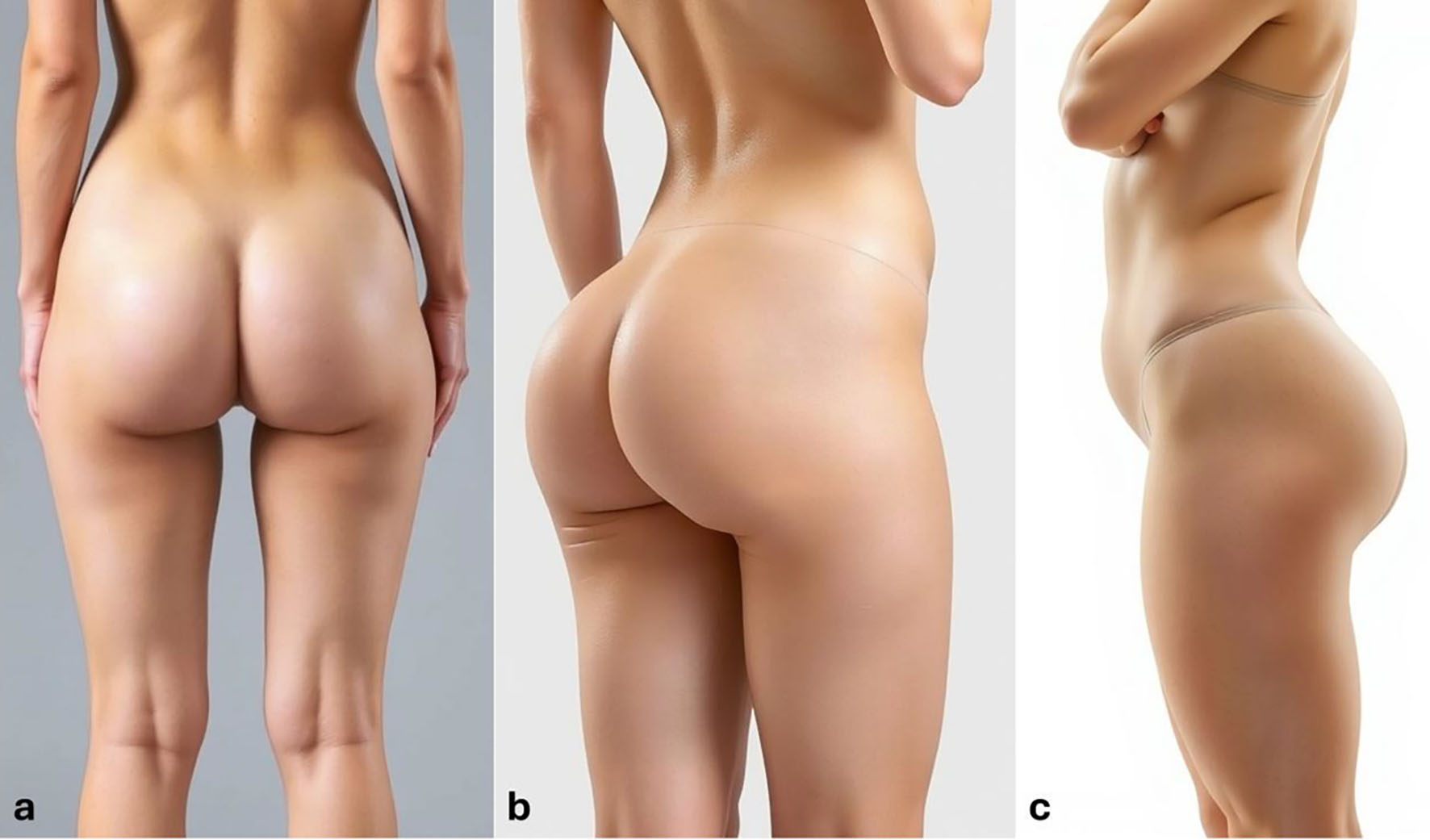 Click for large image | Figure 1. Three examples of the images created with genAI: (a) posterior view, (b) 45° view, (c) side view. GenAI: generative artificial intelligence. |
Dataset and stimulus preparation
Sixty distinct images were included across posterior, lateral, and 45° oblique views; six were repeated for within-rater assessment.
Raters and scoring
Sixteen physicians (eight board-certified plastic surgeons and eight plastic surgery residents; ages 25–65 years, mean 37.4 years; nine women and seven men) independently rated the 66 presentations. All participants took part voluntarily. No personal or identifying data, aside from sex and age, were collected. Resident participation was voluntary and free of supervisory pressure.
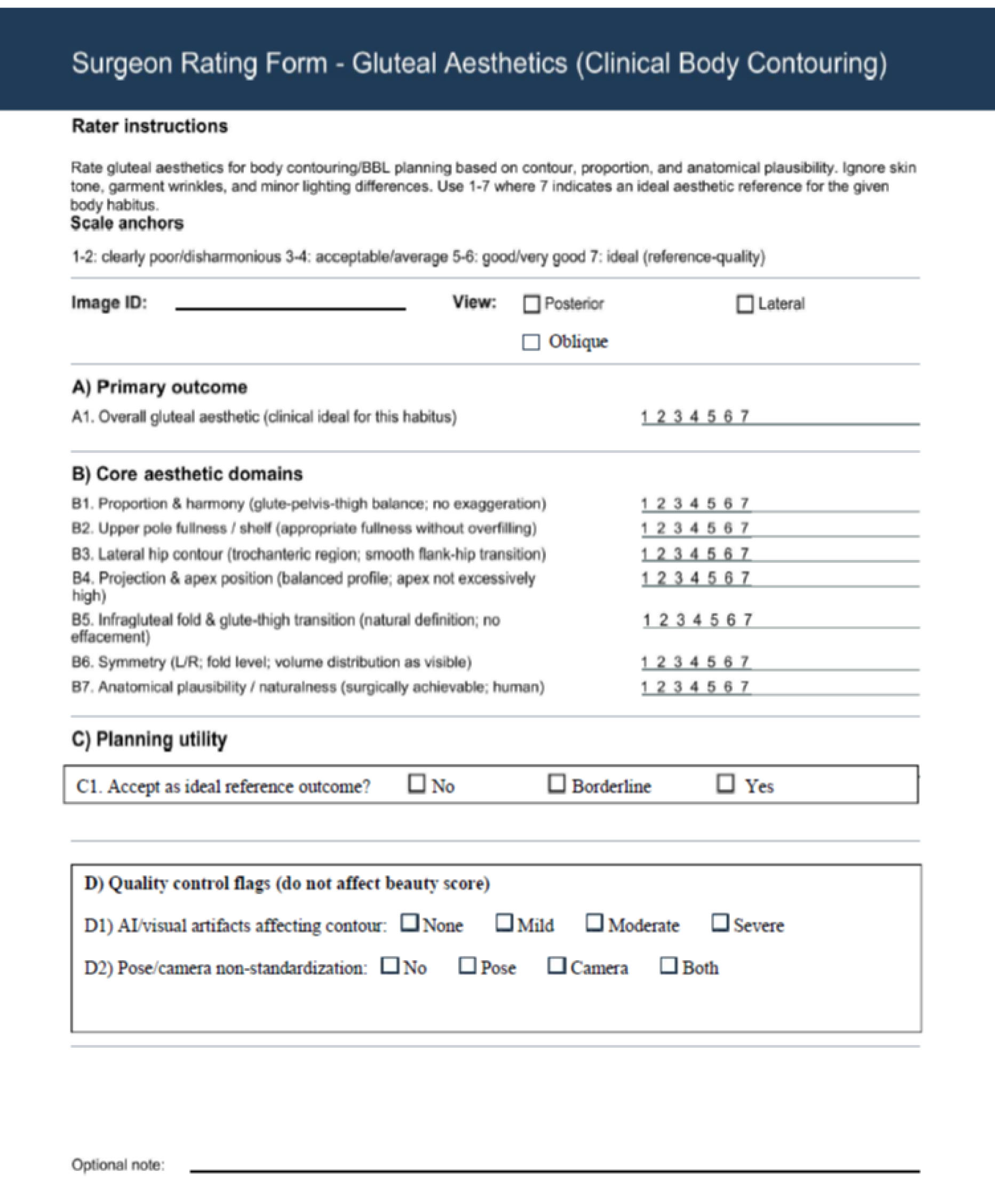
For each image, participants were first asked to evaluate the overall esthetic appearance of the gluteal contour (A). In a second section, we then asked to evaluate seven different beauty parameters: (B1) proportion and harmony; (B2) upper pole fullness; (B3) lateral hip contour; (B4) projection; (B5) infragluteal fold; (B6) symmetry; (B7) anatomical plausibility—naturalness. We asked also whether the proposed image could be considered that of an ideal female buttock: (C1) was recorded as a categorical “ideal reference outcome” response (Yes/Borderline/No). At the end of the test, two additional questions were asked as “control quality flags”: (D1) whether, in the respondent’s opinion, artifacts generated by AI were present (none, mild, moderate, severe), and (D2) whether there were errors due to the framing of the photograph or the model’s pose. The rating form is reproduced in its entirety in Supplementary Material 2 (psam.elmerpub.com).
To assess intra-rater consistency and provide quality control, we included six duplicated stimuli (10% of the image set). Duplicates were distributed throughout the sequence to minimize recognition effects. The duplicated image pairs were 29–63, 16–60, 57–62, 4–22, 11–36, and 31–47.
Scores were summarized descriptively as means and standard deviations (SDs), with ordinal distributions recommended because of the bounded scale. Two-way random-effects absolute-agreement intraclass correlation coefficient (ICC, 2, 1) and ICC (2, 16) were obtained separately for A and B1–B7, each with 95% confidence intervals (CIs) [29, 30].
| Results | ▴Top |
Sixteen raters evaluated 66 presentations each (1,056 image-level evaluations; 60 distinct images plus six duplicates) (Tables 1–3). Pooled means ± SD were A 6.11 ± 1.00; B1 6.22 ± 1.00; B2 6.13 ± 0.98; B3 6.09 ± 1.01; B4 6.19 ± 0.96; B5 6.11 ± 1.00; B6 6.34 ± 0.94; B7 6.30 ± 1.00 (Table 4). The reported ICC (2, 16) range was 0.586–0.805; per-domain ICC (2, 1), ICC (2, 16), and 95% Cronbach’s alpha was 0.951 for 1,053 complete records. This high alpha may partly reflect redundancy among domains. High means close to the scale maximum suggest a ceiling effect.
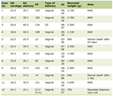 Click to view | Table 1. Reliability and Internal Consistency |
Click to view | Table 2. C1: Ideal Female Butt Classification |
Click to view | Table 3. Intra-Rater Consistency |
Click to view | Table 4. Pooled Scores (Mean ± SD) |
Across the six concealed duplicate pairs, the reported pooled mean absolute rating difference was 0.46 points; exact agreement was 60.6%, and agreement within ±1 point was 93.6%. These descriptive repeatability measures do not establish strong absolute inter-rater agreement or stable generator output.
The overall distribution (all 1,056 responses) of column C1 (“Is the image an ideal female butt?” Yes/Borderline/No) for the 1,056 responses was as follows:
- Y (Yes): 693/1,056 = 65.6% (95% CI 62.7–68.4%)
- B (Borderline): 159/1,056 = 15.1% (95% CI 13.0–17.3%)
- N (No): 204/1,056 = 19.3% (95% CI 17.0–21.8%)
Thus, 65.6% of image-level responses classified the stimulus as ideal; the separate Borderline category accounted for another 15.1%.
Regarding the final points (control quality flags), we reported the following results (Table 5):
Click to view | Table 5. Quality Control Flags |
D1—AI/visual artifacts affecting contour (N/Mi/Mo/S):
- N (None): 962/1,056 = 91.10% (95% CI 89.23–92.67);
- Mi (Mild): 52/1,056 = 4.92% (95% CI 3.77–6.40);
- Mo (Moderate): 39/1,056 = 3.69% (95% CI 2.71–5.01);
- S (Severe): 3/1,056 = 0.28% (95% CI 0.10–0.83).
D2—Pose/camera non-standardization (N/P/C/B):
- N (No issue): 971/1,056 = 91.95% (95% CI 90.15–93.44);
- P (Pose): 80/1,056 = 7.58% (95% CI 6.13–9.33);
- C (Camera): 2/1,056 = 0.19% (95% CI 0.05–0.69);
- B (Both): 3/1,056 = 0.28% (95% CI 0.10–0.83).
| Discussion | ▴Top |
Esthetic procedures involving the female body contour are highly prevalent, motivating efforts to define reference lines and landmarks that are as objective and quantifiable as possible. Such frameworks aim to describe key features of body contour and identify reproducible geometric relationships among anatomical structures.
Several patterns emerged from the analysis of AI-generated images intended to represent “idealized” female gluteal esthetics. Taken together, the rating data indicate that surgeons’ assessments were sufficiently consistent to support interpretation of recurrent esthetic patterns across the generated images. In the posterior view, the generated images showed strong correspondence with gluteal shape categories previously described by Mendieta et al. [4, 13, 14]. In the lateral view, the “idealized” gluteal profile was broadly consistent with descriptors reported by Roberts et al. [19] and Lee et al. [22], including an overall semicircular appearance, an apex of projection located near the midpoint of the curve, and the absence of marked gluteal prominence inferior to the infragluteal fold.
Historically, the waist-to-hip ratio (WHR), often cited around 0.7, has been considered a key descriptor of female body attractiveness [31, 32]. More recent work has shifted attention toward more complex descriptors of body shape, including curvature and “curviness” [33–35]. While WHR is computed from discrete anthropometric locations—often corresponding to points of high curvature—curvature-based descriptors may capture additional aspects of body shape that influence esthetic perception. Nonetheless, although body curves are readily perceived, they remain challenging to formalize and quantify. Notably, as early as the 18th century, William Hogarth [36] described an S-shaped line as a salient feature of visual beauty. Regarding the rear and 45° views, the body contours showed visual similarity with the serpentine lines described by Hogarth, particularly line 4 (Fig. 2). As claimed by Hogarth, this line was to be preferred in many fields, from design to architecture. According to our observation, this line could be esthetically pleasing and attractive precisely because it resembles the body contours of female beauty.
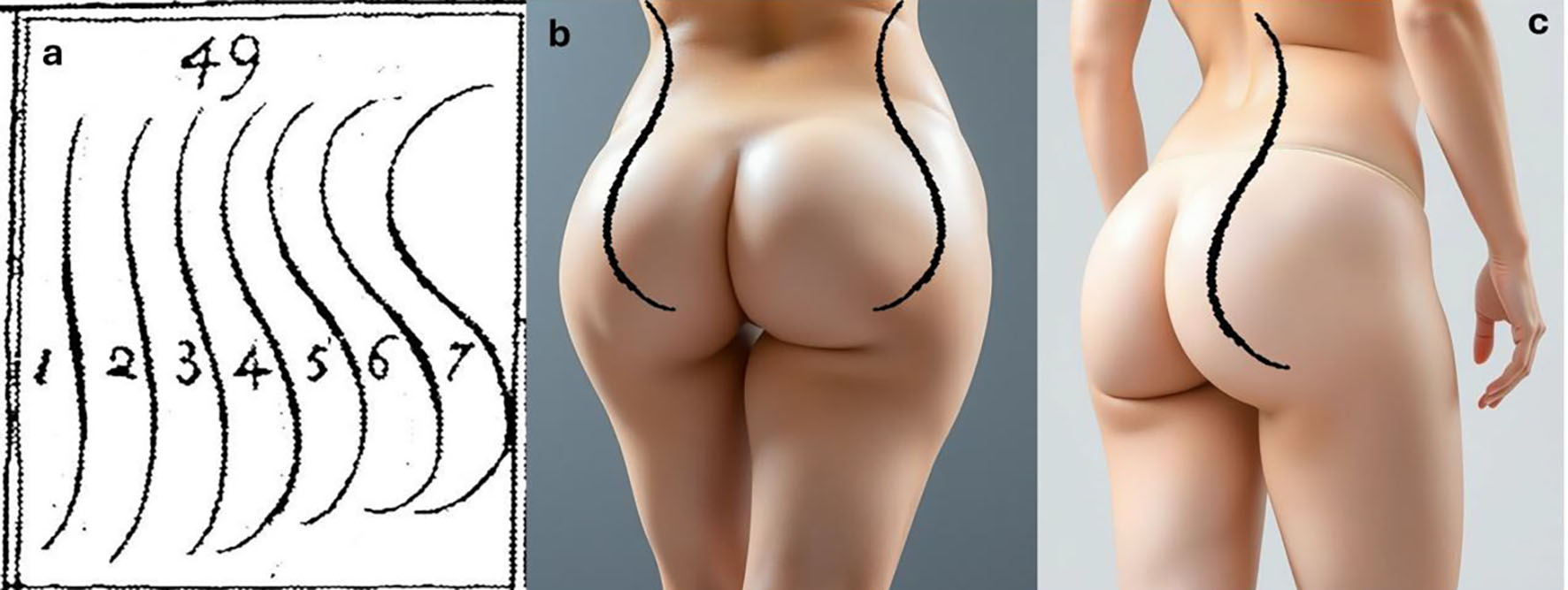 Click for large image | Figure 2. (a) William Hogarth’s illustration of the line of beauty curve 4 compared to other lines (ResearchGate—uploaded by George Mathias Kondolf); (b) Two symmetric 4 curves superimposed on a rear view; (c) The 4-curve superimposed on a 45° projection. |
Regarding the lateral (profile) projections, we noticed how the body contour describes an ovoid-like geometric configuration whose major axis was oriented anteriorly at approximately 60°. In this conceptual model, the ovoid traces the convexities of both the gluteal region and lower abdomen, emphasizing their characteristic transitions (Fig. 3). This orientation may be interpreted as consistent with posture-related changes associated with pregnancy, including increased lumbar lordosis and pelvic adjustments that accommodate anterior mass and a shift in the center of gravity [37]. These biomechanical adaptations include changes in pelvic tilt and spine curvature, which can alter the apparent projection of the gluteal region and the contour of the lower abdomen. In this context, it is plausible that certain curvature profiles may be perceived as more attractive because they resemble configurations associated with biomechanical “optima” during pregnancy. Consistent with this interpretation, Hübner et al reported that female bodies whose lumbar curvature approximates a biomechanical optimum for pregnancy-related demands tend to be rated as more attractive [38].
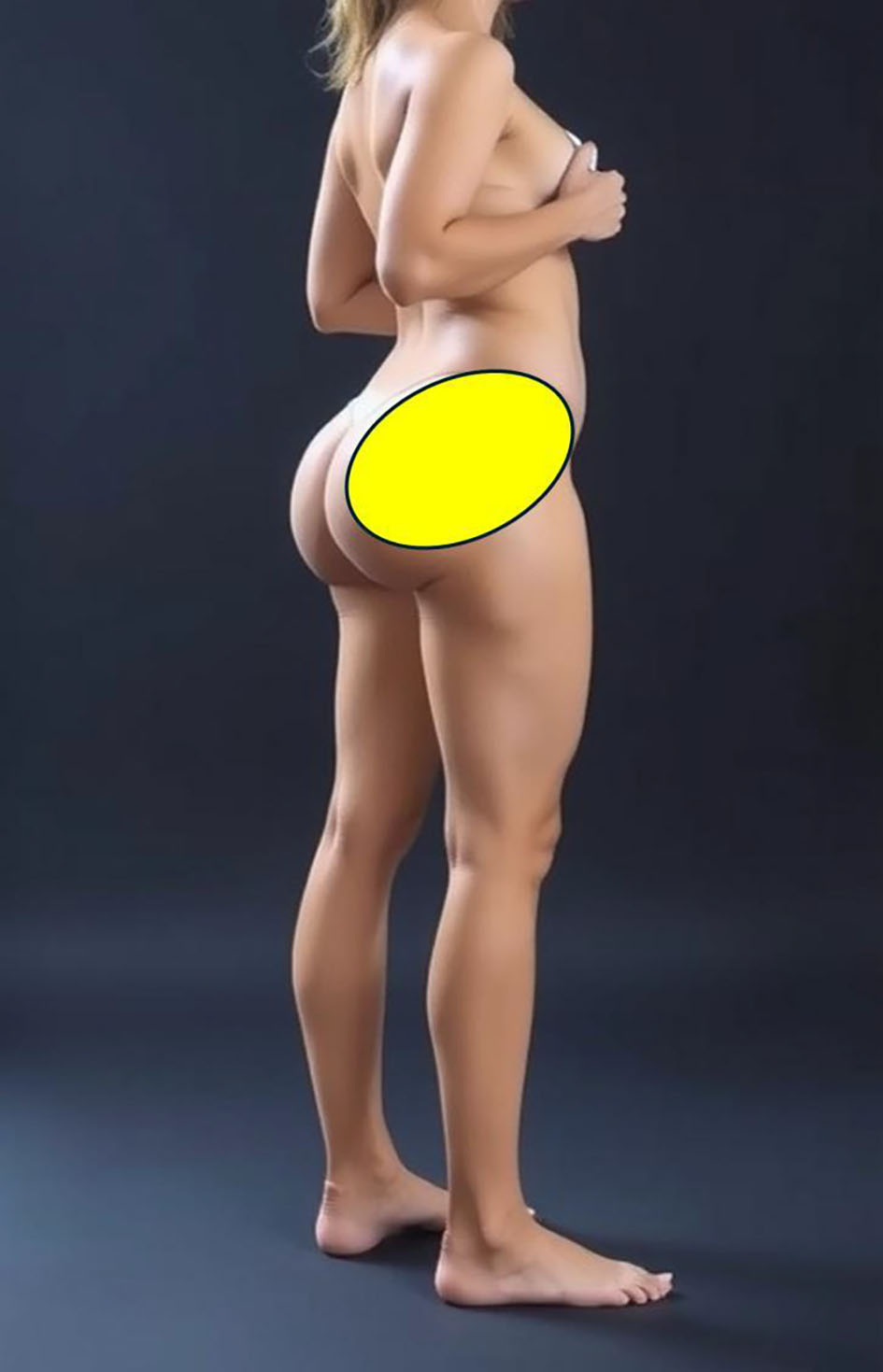 Click for large image | Figure 3. Example of the ovoid inclined forward at 60°. |
Esthetic preferences for body shape are not necessarily temporally or culturally stable. Preferences may vary across contexts and time periods, and their determinants are complex. Accordingly, while curviness has been proposed as a strong predictor of perceived attractiveness—potentially exceeding WHR in predictive value—the interpretation of curviness as a fitness cue versus a broader social or cultural signal remains debated [39].
In our study, of 1,056 image-level judgments, 65.6% were Yes, 15.1% Borderline, and 19.3% No.
Favorable ratings and a high frequency of unflagged images indicate perceived visual acceptability within this selected stimulus set, but not anatomical correctness or reproducibility of the generating system.
The reported ICC (2, 16) range describes the reliability of averages across 16 physicians and must not be interpreted as equivalent to single-rater agreement. Values of 0.586–0.805 span different interpretation bands under commonly used ICC criteria. Duplicate assessments provide descriptive evidence of within-rater repeatability, but the moderate reported test–retest ICC range, where confirmed, should not be labeled unqualifiedly as good. Moreover, the very high mean ratings and restricted score range may influence ICC estimates and reduce discrimination between stimuli.
Quality-control responses were assigned by raters after image presentation, rather than arising from a validated pre-screening process. D2 identified pose issues in 80/1,056 responses (7.58%), camera issues in 2 (0.19%), and both in 3 (0.28%); these deviations may alter apparent gluteal projection and waist–hip geometry and thus confound esthetic scores. A paired image-level sensitivity analysis excluding flagged ratings or images would be informative but cannot be completed without the source data.
In research settings, carefully labeled synthetic images may be useful as exploratory visual stimuli for studying esthetic judgments. Their use as patient-specific operative targets, predictors of outcomes, or medico-legal standards is not supported by the present study and would require external validation against real anatomy, patient preferences, and clinical outcomes.
Limitations
Limitations include a small convenience sample of 16 physicians, potentially dependent resident ratings, absence of a lay comparison group, lack of documented sampling and rejection criteria for generated images, unverified generation settings, possible pose/camera confounding, limited body-habitus diversity, and high scores suggesting a ceiling effect. The 1,056 observations are repeated ratings of 66 presentations and cannot be treated as independent persons or independent generated images. The 60 distinct outputs were not regenerated under identical conditions; therefore, model stability remains untested.
Conclusions
The study suggests that this selected set of synthetic images often received favorable physician assessments and that duplicate evaluations showed measurable within-rater consistency. It does not demonstrate generator reliability, universally preferred body proportions, or suitability for clinical and medico-legal use. Future studies should document complete generation logs, random or prespecified image selection, independent artifact screening, repeated independent generations, broader raters, and prospective comparisons with clinical photographs.
| Supplementary Material | ▴Top |
Suppl 1. GenAI Prompt. GenAI: generative artificial intelligence.
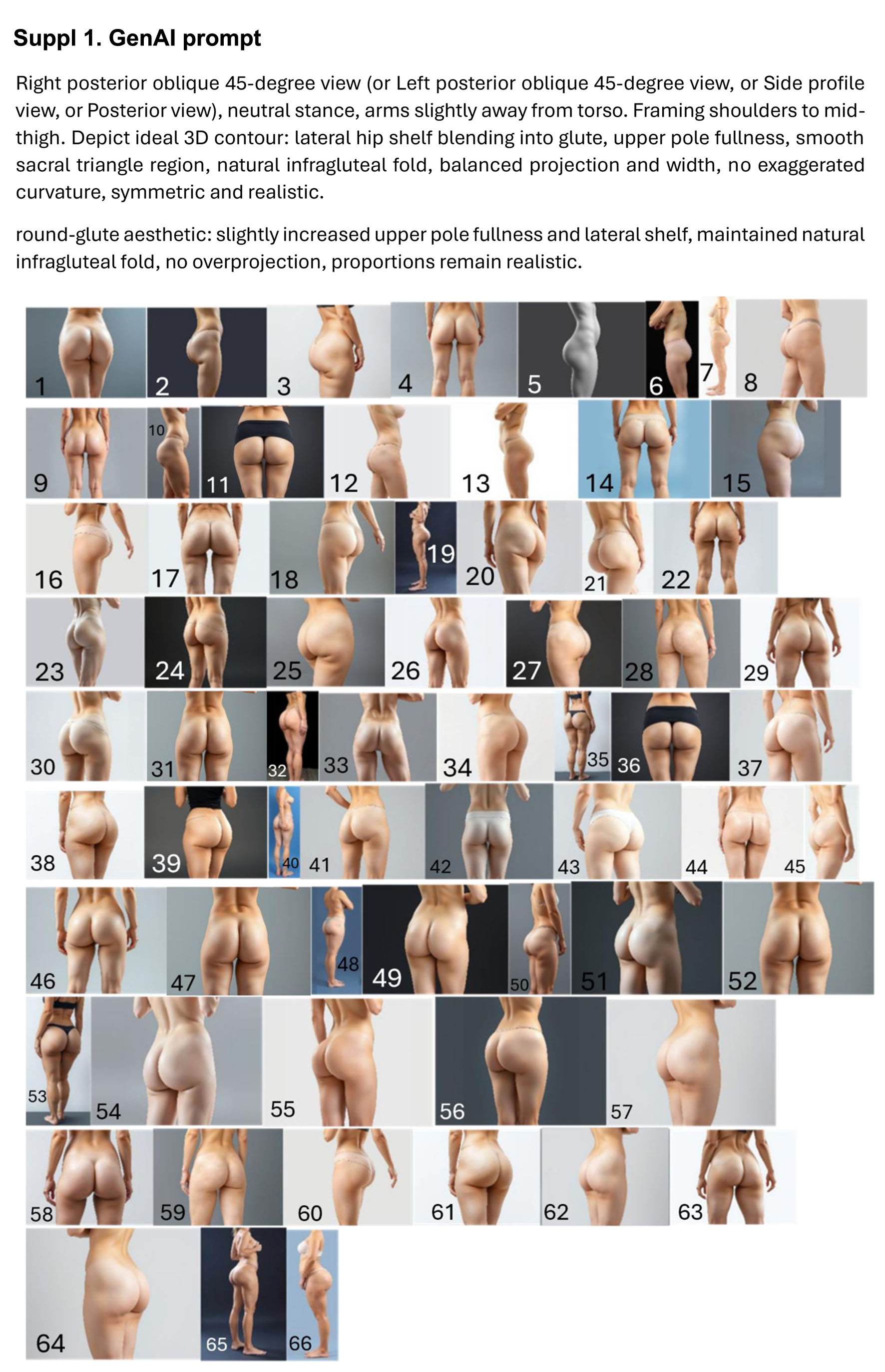
Suppl 2. Surgeon Rating Form.
Acknowledgments
None to declare.
Financial Disclosure
No external funding was received for this study.
Conflict of Interest
The authors declare that they have no conflicts of interest to disclose.
Informed Consent
Not applicable.
Author Contributions
ER: conceptualization, methodology, design of the study and supervision. EB: data curation, writing, and validation.
Data Availability
Any inquiries regarding supporting data availability of this study should be directed to the corresponding author.
AI Use Declaration
ChatGPT GPT-5.2 Thinking was used for prompt drafting; images were generated using FreeGen.app as described in the Materials and Methods section.
Abbreviations
CI: confidence interval; genAI: generative artificial intelligence; ICC: intraclass correlation coefficient; SD: standard deviation; WHR: waist-to-hip ratio
| References | ▴Top |
- Danilla S, Micheli D. Aesthetic ideals of the female buttocks: concepts and techniques. Clin Plast Surg. 2023;50(4):533-540.
doi pubmed - Raposio E, Brocca S, Raposio G. Relationship between the ideal female buttock and the golden ratio. Plast Reconstr Surg Glob Open. 2024;12(9):e6183.
doi pubmed - Vartanian E, Gould DJ, Hammoudeh ZS, Azadgoli B, Stevens WG, Macias LH. The ideal thigh: a crowdsourcing-based assessment of ideal thigh aesthetic and implications for gluteal fat grafting. Aesthet Surg J. 2018;38(8):861-869.
doi pubmed - Mendieta C, Stuzin JM. Gluteal Augmentation and Enhancement of the Female Silhouette: Analysis and Technique. Plast Reconstr Surg. 2018;141(2):306-311.
doi pubmed - Raposio E, Baldelli I, Vappiani M, Gualdi A, Raposio G. The ideal buttock: Some aesthetic and morphometric considerations. Eur J Plast Surg. 2023;46:915-921.
- Danilla S, Troncoso E, Jara R, Dominguez C, Albornoz C, Erazo C, Sepulveda S, et al. What makes a beautiful buttock beautiful? A case-control study comparing buttocks models versus normal women by magnetic resonance imaging, photography and anthropometry. Aesthetic Plast Surg. 2023;47(5):1896-1904.
doi pubmed - Raposio E, Bertulla E. Lateral thigh reference line in body contouring. Plast Surg (Oakv). 2026:22925503261425668.
doi pubmed - Raposio E, Bertulla E. Geometric features of female beauty: the anterior torso. Eur J Plast Surg. 2026;49:71.
- Dorfman RG, Gupta N, Saadat S, Delong M, Roostaeian J. Gluteal shape framework for augmentation surgery: a systematic review of the literature and proposed classification system. Plast Reconstr Surg. 2023;151(5):748e-757e.
doi pubmed - Cesar Duran Vega H. Buttock and full body contouring harmony. Clin Plast Surg. 2023;50(4):573-585.
doi pubmed - Raposio E, Baldelli I. Preoperative planning of gluteoplasty and BBL: some considerations on the aesthetics of female buttocks. Acta Biomed. 2025;96(3):16916-16921.
- Raposio E, Bertulla E. Defining female gluteal geometry for preoperative planning in body contouring. JPRAS Open. 2026;50:456-460.
doi pubmed - Mendieta CG. Classification system for gluteal evaluation. Clin Plast Surg. 2006;33(3):333-346.
doi pubmed - Mendieta CG, Sood A. Classification system for gluteal evaluation: revisited. Clin Plast Surg. 2018;45(2):159-177.
doi pubmed - Nteli Chatzioglou G, Govsa F, Gokmen G, Bicer A. Analysis of the thigh aesthetic profiles: one of physical ideal body proportions. Aesthetic Plast Surg. 2024;48(12):2294-2305.
doi pubmed - Raposio E, Morello A, Raposio G. The "Arrow Factor" in Gluteoplasty and Brazilian butt lift. Plast Reconstr Surg Glob Open. 2025;13(1):e6468.
doi pubmed - Raposio E, Morello A, Bertulla E, Santori G. The “ideal” Southern European female buttocks: a socio-demographic analysis. Eur J Plast Surg. 2026;49:43.
- Kirwan L. Aesthetic units and zones of adherence, relevance to planning incisions in body contouring surgery. Plast Reconstr Surg Glob Open. 2023;11(6):e5093.
doi pubmed - Roberts TL, 3rd, Weinfeld AB, Bruner TW, Nguyen K. "Universal" and ethnic ideals of beautiful buttocks are best obtained by autologous micro fat grafting and liposuction. Clin Plast Surg. 2006;33(3):371-394.
doi pubmed - Raposio E, Bertulla E. Navel aesthetics and arrow effect. Eur J Plast Surg. 2025;48:106.
- Raposio E, Bertulla E. Details of the female figure in profile according to Leonardo da Vinci. JPRAS Open. 2026;49:355-357.
doi pubmed - Lee EI, Roberts TL, Bruner TW. Ethnic considerations in buttock aesthetics. Semin Plast Surg. 2009;23(3):232-243.
doi pubmed - Centeno RF, Sood A, Young VL. Clinical anatomy in aesthetic gluteal contouring. Clin Plast Surg. 2018;45(2):145-157.
doi pubmed - Cardenas-Camarena L, Duran H. Improvement of the gluteal contour: modern concepts with systematized lipoinjection. Clin Plast Surg. 2018;45(2):237-247.
doi pubmed - Raposio E, Bertulla E. The geometry of curviness: the posterior view. Eur J Plast Surg. 2026;49:156.
- Hoyos AE, Perez M. Invited discussion on: optimizing brazilian buttock lift results using the BBL assessment tool: the buttock shape paradox. Aesthetic Plast Surg. 2023;47(2):682-684.
doi pubmed - Mowlavi A, Sin Z, Sahami C, Mantecon G, Mirzania H. Optimizing brazilian buttock lift results using the BBL assessment tool. Aesthetic Plast Surg. 2023;47(2):666-681.
doi pubmed - Bruno A, Cilluffo M. Beyond the Brazilian butt lift: How to objectively measure outcome. Aesthetic Plast Surg. 2025;49(9):2513-2524.
doi pubmed - Shrout PE, Fleiss JL. Intraclass correlations: uses in assessing rater reliability. Psychol Bull. 1979;86(2):420-428.
doi pubmed - Koo TK, Li MY. A Guideline of Selecting and Reporting Intraclass Correlation Coefficients for Reliability Research. J Chiropr Med. 2016;15(2):155-163.
doi pubmed - Singh D. Female mate value at a glance: relationship of waist-to-hip ratio to health, fecundity and attractiveness. Neuro Endocrinol Lett. 2002;23(Suppl 4):81-91.
pubmed - Raposio E, Belgrano V, Santi P, Chiorri C. Which is the ideal breast size? Some social clues for plastic surgeons. Ann Plast Surg. 2016;76(3):340-345.
doi pubmed - Hubner R, Ufken ES. Curviness is a better predictor of a woman's body attractiveness than the waist-to-hip ratio. Sci Rep. 2024;14(1):23081.
doi pubmed - Tovee MJ, Maisey DS, Emery JL, Cornelissen PL. Visual cues to female physical attractiveness. Proc Biol Sci. 1999;266(1415):211-218.
doi pubmed - Fisher ML, Voracek M. The shape of beauty: determinants of female physical attractiveness. J Cosmet Dermatol. 2006;5(2):190-194.
doi pubmed - Naini FB. William Hogarth's The painter and his pug: defining the "line of beauty". Arch Facial Plast Surg. 2010;12(2):136-137.
doi pubmed - Yoseph ET, Taiwo R, Kiapour A, Touponse G, Massaad E, Theologitis M, Wu JY, et al. Pregnancy-related spinal biomechanics: a review of low back pain and degenerative spine disease. Bioengineering (Basel). 2025;12(8):858.
doi pubmed - Hubner R, Lewis DMG, Al-Shawaf L, Semchenko AY, Flores J. Evidence that the aesthetic preference for Hogarth's Line of Beauty is an evolutionary by-product. Sci Rep. 2023;13(1):4134.
doi pubmed - Raposio E, Bertulla E. Relationship between the Hogarth "line of beauty" and the female gluteal profile in western idealized aesthetics. JPRAS Open. 2026;51:249-251.
doi pubmed
This article is distributed under the terms of the Creative Commons Attribution 4.0 International License (CC BY 4.0), which permits unrestricted use, distribution, and reproduction in any medium, including commercial use, provided the original work is properly cited.
Plastic Surgery and Aesthetic Medicine is published by Elmer Press Inc.